We place value judgments on our emotions, our bodies, the food we eat, or what movies we relax with. This is built into the way we talk and think about our lives. It’s generally based around word connotation or the way we are taught to view everything in our lives.to see things.
A few examples of value judgment languages:
We act as though it’s “bad” to be angry or sad and “good” to be happy or calm as "good".
Eating Oreos is somehow a “cheat food”, “unclean” or that it’s somehow a personal falling that you didn’t choose carrots.
Calling part of our bodies “problem parts”
Saying when we watch the notebook or watch reality TV it’s a “guilty pleasure”.
These value judgements seep into the way we describe our whole self. Framing our sleeves as “disgusting”, “horrible”,“lazy”, “bad” etc.
Why is this harmful?
This language affects us so much. It changes how we view our choices and actions. Attaches shame to things that aren’t shameful, causes fear around being who we are and it reinforces negativity and sets unattainable goals This is especially harmful because it throws the whole way you interact with yourself and the world out of focus and can cause you to stagnate. It becomes if I am “a gross person” then integral to you instead of a passing thought your having. Now it’s “I can’t feel better, I’ll always be this way”.
So how do we break out from this?
When you find yourself using value-based language switch it up.
Instead of "Don’t to be angry" try and reframe it “I’m angry and that’s my emotion and it’s valid, now let me find a way to deal with it”
Instead of “I cheated and ate the cake god how could I make that mistake” reframe it as “I ate cake today that’s fine.”
Instead of “I didn’t do X so I’m just a lazy person” can become “I was tired today and I didn’t get it done, that’s okay I can rest and mak a plan tomorrow”
Instead of “I’m a disgusting person because X thing happened” replace it with “That happened and it was upsetting but it doesn’t change my worth”
Placing value judgments may feel right in the moments either were upset with ourselves or we’ve been trained to see things as good or bad. When we stop judging everything and learn to view things with acceptance it improves our self-perception and makes it easier to move forward and even improve when we need to.
You’re literally always on my dash and I just now realized that I wasn’t following you ???? like what????
I just laughed at this thinking ‘man how could you not realize your following them!’ Then I realized I’m not following you either but I always thought I was.
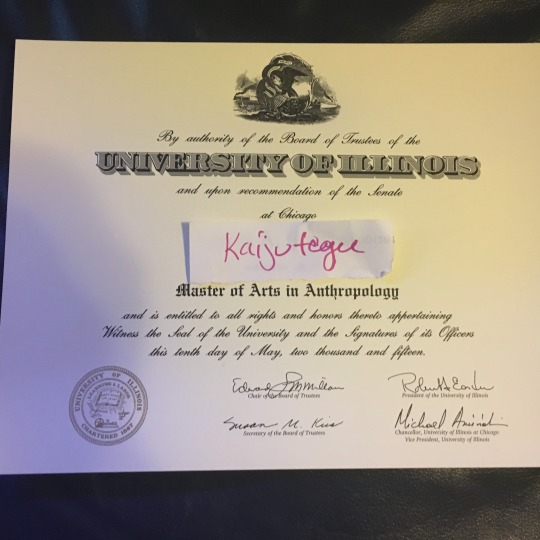
This is my masters’ degree in anthropology. I’d show you my BA, but it’s at my parents’ house. I’m three and a half years into a PhD in physical anthropology. I’ve been employed to do physical anthropology at one of the world’s best natural history museums. My area of study? Teeth and diets. I’m not here to argue veganism or vegetarianism, I’m here to tell you, point by point, why you’re devastatingly misinformed about our place in the primate family tree, along with my peer-reviewed sources behind the jump. I know we live in a “post-truth” society so maybe being presented with the overwhelming consensus of the scientists who currently work with this material is meaningless to you, and honestly, this probably isn’t going to make a bit of difference for you, but I can’t let this slide. Not in this house built on blood and honor. And teeth.
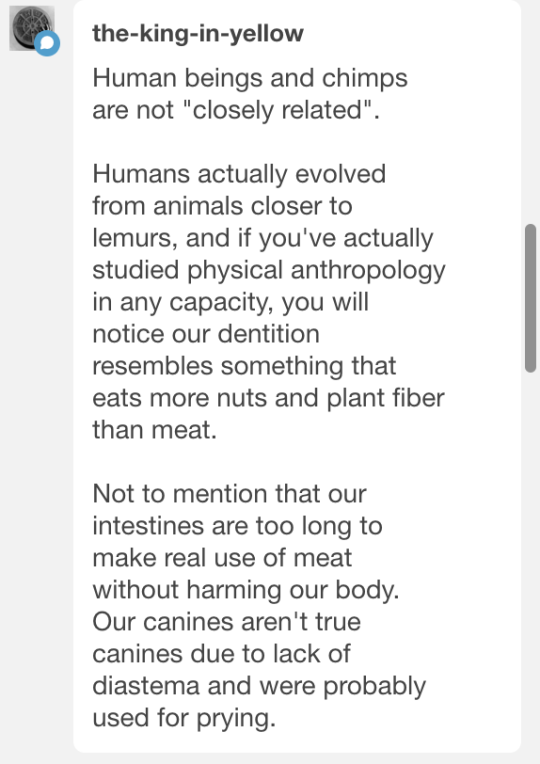
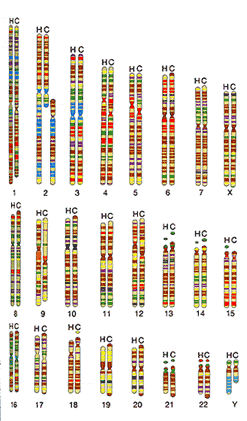
1. The evidence for being closely related to chimpanzees is vast and well-understood thanks to advances in DNA analysis. We share a huge amount of DNA with them, and not just repeating patterns in non-coding DNA. We have numerous genes that are identical and likely diverged around 7 million years ago, when Sahelanthropus tschadensis was roaming the earth. S. tschadensis was a woodland species with basal ape and basal human-line traits. The most notable was the positioning of the foramen magnum towards the central base of the skull and not emerging from the back suggests bipedality. This, along with other traits such as small canines worn at the tip, which implies a reduced or absent C/P3 honing complex (the diastema), suggests that this is actually a basal trait and the pronounced diastema we see in other species was a trait that came later. But more on that later- back to chimps and what we mean by sharing DNA. Our chromosomes and chimp chromosomes are structured far more like each other than other mammals. Furthermore, the genes located on these chromosomes are very similar. Chromosome 2, for instance, is nearly identical to two chimpanzee chromosomes. (Chromosome 2 in humans, Neanderthals, and Denisovans is different from Chromosome 2 found in apes and is actually the remnant of an ancient mutation where Chromosome 2 and 3 merged- you can see that from its vestigial centromeres and the genes found on it. We can’t get DNA from fossil material, but Neanderthal and Denisovan subfossils have demonstrated that this reduced chromosome count- we have one fewer pair than apes- is a typical trait of the Homo genus). Here’s a side by side comparison of Human and chimpanzee chromosomes.
Gene coding regions are colored- bands at the same place mean that there’s two identical genes at that locus. Our similarities to lemurs, on the other hand, aren’t on homologous chromosomes. We have similar coding around the centromeres but the genes express themselves differently. The structure of non-ape primate genes is also significantly different; when the first chromosomal comparisons were done between humans and lemurs back in the 1990s, it was discovered that lemurs have much more highly-concentrated heterochromatin at their centromeres, whereas the structure of human and chimpanzee centromeres is similar. The major differences in chimp and human DNA are in the noncoding regions; most of our genes have identical structures.
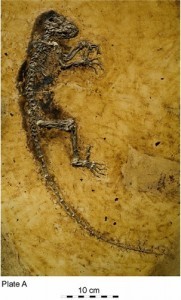
2. All primates evolved from a lemur-like organism, not just humans. Here’s one of them. I’ve seen her in person. Pretty cool, huh?
Her name is Ida and she’s a member of the genus Darwinius. But that’s just like saying all primates evolved from something that was basically a tree shrew- which is also true. See, one of the main points of evolution is that organisms are continually changing throughout time. We didn’t jump from lemur-like organism to human; changes were slow and gradual and the lineage isn’t really a straight tree. The fossil species we have and know lead to different lines branching out. Some things died off, some things flourished. Heck, look at the Miocene- twelve million years ago, there were hundreds of ape species. Now there’s twenty-three. (Sixteen gibbons, two chimp species, two gorilla species, two orangutan species, and one human species. There’s also some subspecies of gorilla and gibbon, but I’m only counting the primary species.) It’s hard to trace things back, but saying that we evolved from lemur-like species is obtuse and obfuscates the real point, which is that Homo and Pan descended from a relatively recent-in-the-grand-scheme-of-things common ancestor.
3. Our dentition is unique to the extant primates, but not australopithecines. Our teeth look very much like other members of the genus Homo, the extinct ones, as well as many of the australopithecines. We also have very similar enamel proportions to gracile australopithecines; apes have much thinner enamel overall.
But what did australopithecines eat?
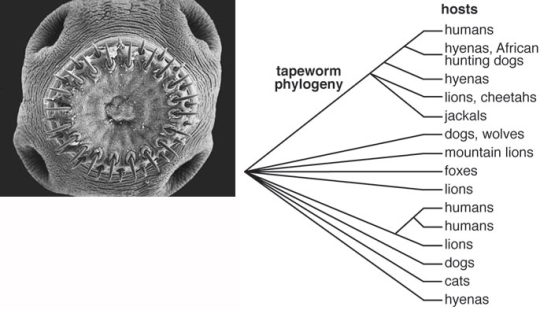
Everything. We know they were eating fruits and nuts based on microwear analysis and strontium analysis, but we also know they were eating meat- and in pretty decent quantity, too. We’ve found all kinds of butchering sites dating back millions of years and in association with Australopithecus garhi, the earliest tool user, but we can also see this in tapeworm evolution. There’s many, many species of tapeworm in several genera. But three of them, in the genus Taenia, are only found in humans. And these species diverged from… carnivore tapeworms. Their closest relatives infect African carnivores like hyenas and wild dogs.
Tapeworms that are adapted to the specific gut of their host species need a certain environment, as well as a specific cycle of infection so that it can reproduce. A tapeworm that infects hyenas is going to be less successful if it somehow makes the jump to a horse. But if the hyena tapeworm was able to adapt to our gut, that suggests that our stomach was hospitable enough for them chemically to survive- which brings me to the intestines.
4. Our intestines are also unique. Yes, we have longer intestines than carnivores, but we also don’t have cecums like herbivores. We are omnivores and that means we still needed to retain the ability to digest plants.
The key to being omnivores is omni. All. I’m not saying we should only be eating meat, I’m saying our ancestors ate a varied diet that included all kinds of things. If we weren’t omnivores, why would we have lost the cecum’s function? Why is the human appendix only a reservoir for the lymphatic system, as it is in carnivores? The cecum is an extremely important organ in herbivores, as it houses the bacteria needed to break down cellulose and fully utilize fiber from leaves. But we don’t have that. Instead, we compensate with a long gut. Our ancestors absolutely did eat fruits and nuts and berries, but they also ate other stuff. Like scavenged carcasses and bugs and probably anything they could fit in their mouths. Which- actually, primate mouths are interesting. Humans and chimpanzees have enclosed oral cavities, thick tongues, and jaw angles much more like herbivores than carnivores- suggesting a herbivorous ancestor. That’s not something I’m arguing against at all. But again, we have adaptations for eating meat and processing animal protein because we are an extremely opportunistic species.
5. Our canines are true canines. First, semantics: having a diastema does not canine teeth make. We refer to the canine teeth by position- even herbivores, like horses, have them. They’re the teeth that come right after the incisors. All heterodonts have the potential same basic tooth types- incisors, canines, premolars, molars- in various combinations and arrangements. Some species don’t have one type of teeth, others don’t have any- but it’s silly to say that the canine teeth aren’t canine teeth just because they don’t serve the same function as a gorilla’s or a bear’s or some other animal’s. It’s basic derived versus primitive characteristics.
Now that we’ve got semantics out of the way, let’s talk about that diastema. The lost diastema is a derived trait, which means that our ancestors had it and we lost it over time. All other extant non-Homo primates have a canine diastema. All of them. However, when you look at australopithecines, we see that many of them either don’t have it or have it in a reduced capacity. At the earliest known hominin site, Lukeino, we see Orrorin tugenensis with reduced canines compared to ape fossils and modern apes- and… you do know that apes don’t use their canines for eating meat, right? Like, primate canines serve a very different purpose than carnivorans’ canines. It’s suggested that the large canines are for social display moreso than anything dietary- bigger, more threatening teeth are useful if you’re a gorilla or chimpanzee fighting to the top of your group’s social structure.
I’m going to refer you to a blog post written by Dr. John Hawks, a good friend of my advisor and generally a pretty cool guy. He’s got a nice writeup on the evolution of hominin teeth and how the human line’s teeth have changed through time.
Also, of course our teeth are going to be smaller. When we compare archaic Homo sapiens fossils to modern skeletons, their teeth and jaws are much more robust. This is likely related to the introduction of soft foods- and by soft, I mean cooked grain mush- to the diet around the time of domestication, right before the population explosion that happened about 10k years ago. In general, post-domestication human jaws are much smaller and more crowded than any other humans and hominins that came before.
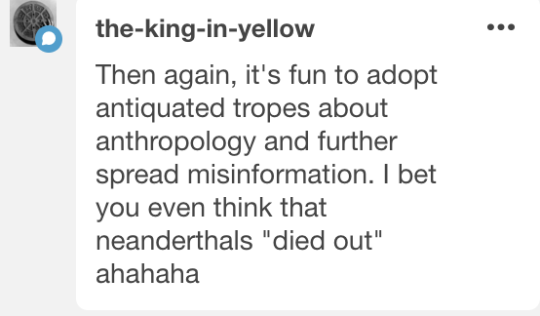
6: Neanderthals did die out, but not in a catastrophic event like we think of with dinosaurs. While there are no living Neanderthals today that we would classify as Homo neanderthalensis, there is plenty of evidence that we interbred and likely outcompeted them as a species due to our overwhelmingly large population size (hypothesized based on number and locations of remains found). While there’s only a small percentage of Neanderthal mitochondrial DNA lines in human populations today, it’s quite likely we lost a lot of that due to genetic drift and population migration- Neanderthals, after all, had a much more limited range than Homo sapiens sapiens. Their eventual extinction is a mosaic of events- outcompetition plus assimilation. The line between Homo sapiens sapiens and Homo neanderthalensis/Homo sapiens neanderthalensis is blurry- there’s some physical anthropologists who actually think we should be including them within our species as a subspecies- but they are extinct in that the specific subset of hominins with distinct karyotypes and potential phenotypes no longer exists.
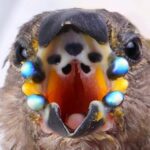
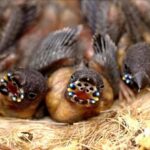
Gouldian Finch chicks are born with phosphorescent beads around their mouths which glow in the dark. This helps their parent’s to feed them in the pitch black.
Top 10 Dinosaur Features That Will Never Fossilize
Productivity culture will deceive you (especially if you are particularly high-functioning or a former Gifted Kid) into thinking that any use of your time that can’t be monetized or leveraged for your personal advancement is worthless, and I’m here to tell you that’s the devil talking. Do shit because you like it.
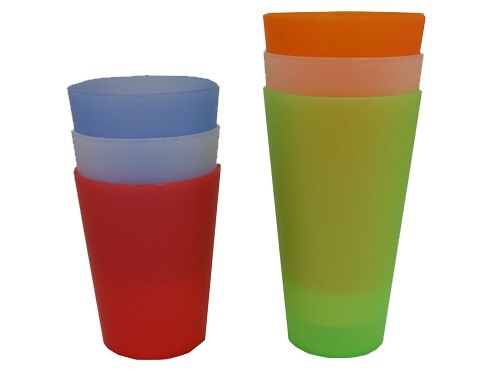
Another Forbidden Texture: those frosted, semi-translucent colorful plastic cups with the grainy surface texture.
Absolute hell. The fact that I lack a long proboscis after being served fluids in cups like these when visiting other people’s houses disproves Lamarckism.
Oh shit, and special acknowledgement of those microfiber towels meant for cleaning windows and glasses. Horrific.
1. Right now there are maybe seven billion people in the world, and no doubt there is a lot of leeway in the estimates we could make, but let us say that a hundred million of those people are fucking. That is a lot of fucks. I do not give any of those fucks.
2. Consider also the bears, doing in the woods what bears have done in woods since time immemorial, which is to say fucking. Or the squirrels, or the wolves, or those little brown fuzzy creatures that live in holes, or anything else for that matter that has got down to it in the cosy, pine-scented dusk. I do not give their fucks either.
3. You know when you see fucking dragonflies float past, happily oblivious to the world? Also not those.
4. In fact the sum total of insect fucks are fucks I do not give. Chitinous beetlefucks? Nope. Fluttering butterflyfucks? Nope. Double-dotted ladybirdfucks? Nope. There are insects in the world undiscovered by humanity whose fucks I do not give.
5. They say that in the city you are never more than ten metres from fucking rats. The quiet, homely fucks of these rats in their rat-niches are also fucks that I do not give.
6. This fuck, that fuck and the other and so on. These happy fucks that I will keep in my memory and treasure, taking them out from time to time to admire. These fucks are mine and I am definitely not giving them.
7. The slowest, loudest, most zoo-patron-embarrassing tortoisefuck.
8. Alien fucks, all across the Universe, comprising: oddly mundane fucks beneath triple stars; the fucking of beings identical to humans but for their oddly lumpy faces; those of a nature tentacular, spectacular and strange; fucks barely comprehendable; those romping through ammonia oceans in the sixteenth dimension; the void-spanning fuckery of intergalactic space narwhals; and others.
9. Then there are various fucks of a metaphorical nature, for example: the fucking of the populace by politicians; the fucking of the planet by humanity; the fucking of humanity by fate. I do not give any of those fucks either.
10. And also all other fucks. Which means, alas, that I am all out of fucks to give.